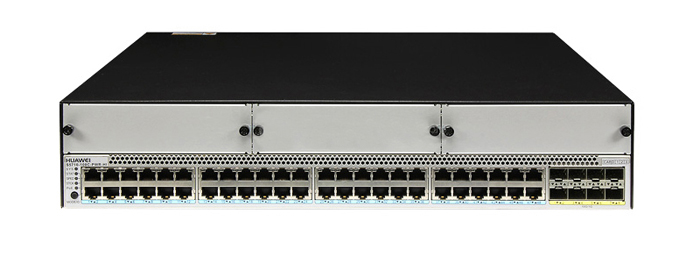
The S5710-108C-PWR-HI is advanced Ethernet switch based on new generation of high-performance hardware and Huawei Versatile Routing Platform (VRP). With 48 GE ports (10/100/1000Base-T) and 8 x 10 GE SFP+ ports, it provides a large switching capacity, high-density GE interfaces for users. What's more, it can be equipped with multiple types of card modules to meet different demands of users, and the PoE function ensures constant large power supply. All these features make the S5710-108C-PWR-HI the best choice as an access switch on large and medium-sized campus networks or data centers and aggregation switch on small campus networks. The S5710-108C-PWR-HI integrates many advanced technologies in terms of reliability, security, and energy conservation in order to help enterprise customers build a next-generation IT network.
Quick Specs
Figure 1 shows the appearance of Huawei S5710-108C-PWR-HI switch.
Note:
Product Code
S5710-108C-PWR-HI
Ports
- 48 x 10/100/1,000 BASE-T ports, - 8 x 10 GE SFP+ ports
Extended Slots
Three slots on the front panel,
One slot at the real panel
Memory (RAM)
1 GB
Flash
200 MB
MAC Address Table Size
456 MAC
Subcard Supported
- Three slots on the front panel: support 16 x 1,000 Base-X SFP subcard and 16 x 10/100/1,000 Base-T subcard - One slot at the real panel: supports 4 x 40 GE QSFP+ subcard and 4 x 10 GE SFP+ subcard
Voltage Required
AC:
Rated voltage range: 100V to 240V, 50/60 Hz Maximum voltage range: 90V to 264V, 50/60 Hz
Power Device
Double swappable AC power supplies
Power Consumption Operational
< 1,680W
(Device: 240W, PoE: 1440W)
Forwarding performance
504 Mpps
Switching capacity
1024 Gbit/s
Dimensions (W x D x H)
442 mm x 470 mm x 87.2 mm
Package Weight
15.3 kg
RPS
Not supported
Product Details
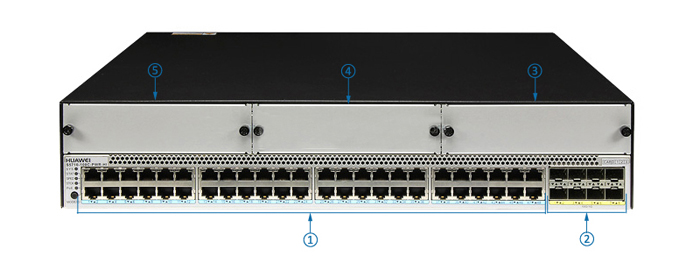
Figure 2 shows the front panel of Huawei S5710-108C-PWR-HI switch.
Note:
①
Forty-eight PoE+ 10/100/1000BASE-T ports
②
Eight 10GE SFP+ ports
③
Front card slot 3
④
Front card slot 2
⑤
Front card slot 1
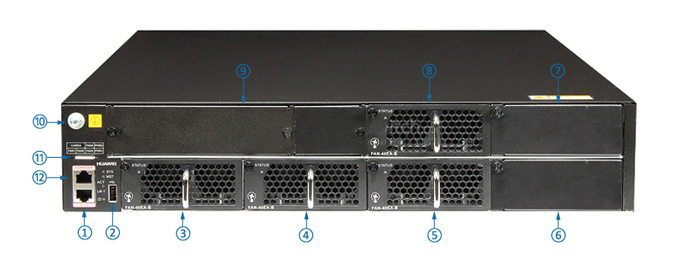
Figure 3 shows the back panel of Huawei S5710-108C-PWR-HI switch.
Note:
①
ETH management port
②
One USB port
③
Fan slot 1
④
Fan slot 2
⑤
Fan slot 3
⑥
Power module slot 1
⑦
Power module slot 2
⑧
Fan slot 4
⑨
Rear card slot
⑩
Ground screw
⑪
ESN label
⑫
One console port
* Ground screw is used with a ground cable.
* You can draw ESN label out to view the ESN and MAC address of the switch.
Recommended Modules
Table 2 shows the recommended modules.
Category
Model
Description
Power Module
W0PSA1701
170W AC Power Module(Used In HI Series)
PAC-350WA-B
350W AC Power Module(Back to Front, Power panel side exhaust)
Static, dynamic, and blackhole MAC address entries
Packet filtering based on source MAC addresses
MAC address entries: 456K
VLAN
4K VLANs
Guest VLAN and voice VLAN
GVRP
MUX VLAN
VLAN assignment based on MAC addresses, protocols, IP subnets, policies, and ports
1:1 and N:1 VLAN Mapping
Ring protection
RRPP ring topology and RRPP multi-instance
Smart Link tree topology and Smart Link multi-instance, providing the millisecond-level protection switchover
SEP
STP, RSTP, and MSTP
BPDU protection, root protection, and loop protection
BPDU Tunnel
Reliability
Ethernet OAM (IEEE 802.3ah and 802.1ag)
ITU-Y.1731
DLDP
LACP
MPLS features
MPLS L3VPN
MPLS L2VPN(VPWS/VPLS)
MPLS-TE
MPLS QoS
Notes
IP routing
Static routing
IPv6 features
Neighbor Discovery (ND)
Path MTU (PMTU)
IPv6 ping, IPv6 tracert, and IPv6 Telnet
ACLs based on the source IPv6 address, destination IPv6 address, Layer 4 ports, or protocol type
MLD v1/v2 snooping
Multicast
IGMP v1/v2/v3 snooping and IGMP fast leave
Multicast forwarding in a VLAN and multicast replication between VLANs
Multicast load balancing among member ports of a trunk
Controllable multicast
Port-based multicast traffic statistics
QoS/ACL
Rate limiting on packets sent and received by an interface
Packet redirection
Port-based traffic policing and two-rate three-color CAR
Eight queues on each port
WRR, DRR, SP, WRR+SP, and DRR+SP queue scheduling algorithms
Re-marking of the 802.1p priority and DSCP priority
Packet filtering at Layers 2 through 4, filtering out invalid frames based on the source MAC address, destination MAC address, source IP address, destination IP address, TCP/UDP port number, protocol type, and VLAN ID
Rate limiting in each queue and traffic shaping on ports
Security
User privilege management and password protection
DoS attack defense, ARP attack defense, and ICMP attack defense
Binding of the IP address, MAC address, interface, and VLAN
Port isolation, port security, and sticky MAC
MFF
Blackhole MAC address entries
Limit on the number of learned MAC addresses
802.1x authentication and limit on the number of users on an interface
AAA authentication, RADIUS authentication, HWTACACS authentication, and NAC







 PRODUCTS

)
 S5710-108C-PWR-HI
 Goods Description:S5710-108C-PWR-HI(48 Ethernet 10/100/1000 PoE+ ports,8 10 Gig SFP+,with 4 interface slots,without power module)

 More…
More…